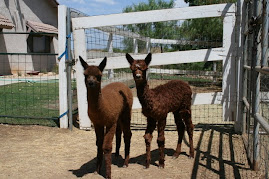
OMG! As you know, last week I changed my mind about my ranch name and officially changed it with ARI. Well this weekend I decided even though I'm still in the planning stages, it wouldn't be a bad thing to put my farm name and website link on my signature in the Alpacanation forum. It was a nightmare. Not because putting a link on a signature is difficult, it's actually very easy. The nightmare was getting a new domain name. Apparently there's an Alpaca Springs farm in Canada. Had I known this, I would have stuck with Suri Springs, even though I will have hucayas. Of course had I simply typed the name in the address bar, I would have known that. Sloppy research bit me in the heiney. I did do some research, I checked AOBA, ARI and Alpaca Nation. but had I taken that last step, I could have saved myself some creative thinking. Especially since some wonderful person has parked the name Alpacasprings farm.com. So I have a .net instead of .com. No biggie, but after my misstep I spent the better part of the day. Wrestling with myself so I didn't make the same mistake.
Now this rushing into a name cost me unnecessary money. Because I didn't live with my name before grabbing it from all over the place, and making sure I really liked the name. I had to pay to change the name with ARI and pay for a new domain name. Granted this time rushing only cost me $25 but the next time it could cost way more. Not to mention the time it took to change the name on this blog, and my email address. Thank goodness I hadn't started using email yet. It sounds simple and the actual actions are but I hadn't realized how many places I was already using my farm name.
Anyway my farm name AlpacaSprings is official and isn't going anywhere. Everything is set-up and ready for building and expanding. I can't wait to have the land and I can put that name over the entrance.
Monday, August 31, 2009


Sunday, August 30, 2009
Responsibly Owning Alpacas
I am an animal lover. Most Alpaca owners are. Like in anything, unfortunately there are a few bad apples. Meaning the greedy and irresponsible.
I can't volunteer in an animal shelter because I couldn't look at those sweet faces and know they would be dead the next day sleep simply becasue they don't have a home. Most of these animals are there because they stopped being cute. Or the owners abandoned them for convenience. I read a thread (slaughter house/ livestock auction thread) that lets me know this also happens with alpacas. I've already decided to make a space on my farm for rescue so if a farmer is in a dire situation the animals don't suffer. I won't have enough room to save the entire population, but even saving a small herd is a step in the right direction.
I'm working on my exit strategy so I don't end up as one of those irresponsible owners. ( I acknowledge there are times when life rears its ugly head and things just happen - I'm not talking about that) I worked up an alpaca life expectancy chart. Across the top, I've listed the years and from the year I'll turn 60 I've noted my age above the year. From the year I'll turn 60 through 70, I colored in gray because I'm just not sure I'll want to have an active farm after 60. Down the first column I've listed the animals I already have and the animals I anticipate acquiring/breeding for over the next five years. (I used my business plan for that list) Then I colored in a life expectancy of twenty years for each animal. I used 20 years because the average lifespan of an alpaca is 15 - 20 years. Some may live longer or shorter, but if I plan for long life, then I have no ugly surprises.
From my chart, if I acquire my goal of 6 breeding females, two fiber animals and three herdsires within my first five years and they all have crias that I don't sell, I acquire no more animals after the fifth year and everyone lives 20 years, my Alpacas will all be gone by the time I turn 65.
I realize that I don't have a crystal ball and I can't predict the future but that's not my goal. My goal is to give myself a realistic idea of what I'm committing to. And not be in a position 20 years from now of having a large herd, realizing I want to retire and having one of those herd dispersal sales. I'll probably never be without alpacas, but there is a difference between having a working farm and having a home with pets.
I think if more people thought out how long the animals they are buying/breeding will live, and gave themselves a visual of what that looks like, life would be better for both the alpacas and the humans who own them.
I can't volunteer in an animal shelter because I couldn't look at those sweet faces and know they would be dead the next day sleep simply becasue they don't have a home. Most of these animals are there because they stopped being cute. Or the owners abandoned them for convenience. I read a thread (slaughter house/ livestock auction thread) that lets me know this also happens with alpacas. I've already decided to make a space on my farm for rescue so if a farmer is in a dire situation the animals don't suffer. I won't have enough room to save the entire population, but even saving a small herd is a step in the right direction.
I'm working on my exit strategy so I don't end up as one of those irresponsible owners. ( I acknowledge there are times when life rears its ugly head and things just happen - I'm not talking about that) I worked up an alpaca life expectancy chart. Across the top, I've listed the years and from the year I'll turn 60 I've noted my age above the year. From the year I'll turn 60 through 70, I colored in gray because I'm just not sure I'll want to have an active farm after 60. Down the first column I've listed the animals I already have and the animals I anticipate acquiring/breeding for over the next five years. (I used my business plan for that list) Then I colored in a life expectancy of twenty years for each animal. I used 20 years because the average lifespan of an alpaca is 15 - 20 years. Some may live longer or shorter, but if I plan for long life, then I have no ugly surprises.
From my chart, if I acquire my goal of 6 breeding females, two fiber animals and three herdsires within my first five years and they all have crias that I don't sell, I acquire no more animals after the fifth year and everyone lives 20 years, my Alpacas will all be gone by the time I turn 65.
I realize that I don't have a crystal ball and I can't predict the future but that's not my goal. My goal is to give myself a realistic idea of what I'm committing to. And not be in a position 20 years from now of having a large herd, realizing I want to retire and having one of those herd dispersal sales. I'll probably never be without alpacas, but there is a difference between having a working farm and having a home with pets.
I think if more people thought out how long the animals they are buying/breeding will live, and gave themselves a visual of what that looks like, life would be better for both the alpacas and the humans who own them.
Saturday, August 29, 2009
It's really a business
I am so proud of myself. I am really starting to look at and treat the Alpaca business like that, a business. I've completed the financial part of my business plan and now I'm on to the fun part - the writing.
I am definite about making space for rescue. And I'll agist as well. Since I'll have a large amount of land I've decided to trade a section of it to a vet so I'll have a vet living on premises. I'll accomplish two goals doing this: 1) I'll have an alpaca vet, 2) The area will have an alpaca vet.
I've already created an Alpaca Information Sheet which I'll require anyone buying animals from me to sign. When I create my website, I'll have this and any other form I create available for download. the AIS form contains a clause acknowledging that I will broker the animals for sale if the client finds they are going out of business or unable to care for the animal. They will be required to pay agisting fees which, hopefully, will keep people from using up an animal and dumping it when it becomes older. I'm also going to require that people have a basic education of alapcas before I sell an animal. I don't see why people don't do that now. Correction, yes I do - they are more interested in making money than the animal's welfare.
I hope this downturn in the economy will purge such people from the alpaca industry.
I am definite about making space for rescue. And I'll agist as well. Since I'll have a large amount of land I've decided to trade a section of it to a vet so I'll have a vet living on premises. I'll accomplish two goals doing this: 1) I'll have an alpaca vet, 2) The area will have an alpaca vet.
I've already created an Alpaca Information Sheet which I'll require anyone buying animals from me to sign. When I create my website, I'll have this and any other form I create available for download. the AIS form contains a clause acknowledging that I will broker the animals for sale if the client finds they are going out of business or unable to care for the animal. They will be required to pay agisting fees which, hopefully, will keep people from using up an animal and dumping it when it becomes older. I'm also going to require that people have a basic education of alapcas before I sell an animal. I don't see why people don't do that now. Correction, yes I do - they are more interested in making money than the animal's welfare.
I hope this downturn in the economy will purge such people from the alpaca industry.
Friday, August 28, 2009
Feeling Good
Every time I turn around, I keep getting more and more positive reinforcement that I have made the right decision gong into the alpaca business. I can't think of another business where most of the people you come across are so nice and generous with their knowledge. After I read that horrifying thread in the AlpacaNation forum about livestock auctions, I made a definite decision to make room on my farm for rescue so that as many of these poor animals as I have space for would have someplace safe until they could find a new home. I was also thinking that I should do like other rescues and have mandatory education for new owners so that the alpacas would go to people who know at least the basics about the animals and their care before taking them home.
From the business classes I've taken, I've learned that the best businesses to study are not the ones that succeed, but the ones that fail. Yes, you look at what works, but you can also learn so much from what doesn't work. Learning from other people's mistakes can save a person a lot of time and wasted energy. To this end, I've gone through the herd disperal ads on AlpacaNation (all 140 of them - yeah 140, very scary) because most people write why they are going out of business. I realize that in today's economy a lot of businesses are struggling and/or closing, but the bad economy isn't the sole reason businesses close. Most new businesses close within one year even in a good economy.
During my research I found a farm that had two herd disperals and it turned out he was doing exactly what I was thinking about doing: providing a safe place for alpacas whose owners have gone out of business. We had a very nice conversation (just shy of an hour) during which he explained the pitfalls of what he was doing and the rewarding side as well. Interestingly enough, he echoed a lot of thoughts I had, including making sure that the animals went to people who knew the basics. After my conversation with him and reading the threads in the forum, I realize that the Alpaca industry is on the cusp of major changes. In order to survive, it's going to have to. Breeding for profit is starting to not work and I have a feeling that those who fail to recognize this are going to be in trouble.
From the business classes I've taken, I've learned that the best businesses to study are not the ones that succeed, but the ones that fail. Yes, you look at what works, but you can also learn so much from what doesn't work. Learning from other people's mistakes can save a person a lot of time and wasted energy. To this end, I've gone through the herd disperal ads on AlpacaNation (all 140 of them - yeah 140, very scary) because most people write why they are going out of business. I realize that in today's economy a lot of businesses are struggling and/or closing, but the bad economy isn't the sole reason businesses close. Most new businesses close within one year even in a good economy.
During my research I found a farm that had two herd disperals and it turned out he was doing exactly what I was thinking about doing: providing a safe place for alpacas whose owners have gone out of business. We had a very nice conversation (just shy of an hour) during which he explained the pitfalls of what he was doing and the rewarding side as well. Interestingly enough, he echoed a lot of thoughts I had, including making sure that the animals went to people who knew the basics. After my conversation with him and reading the threads in the forum, I realize that the Alpaca industry is on the cusp of major changes. In order to survive, it's going to have to. Breeding for profit is starting to not work and I have a feeling that those who fail to recognize this are going to be in trouble.
Wednesday, August 26, 2009
Fiber Education
Finding that AlpacaNation forum has been a Godsend. I knew I had a lot to learn, but after reading the fiber threads, I have a more to learn than I thought. A lot.
I truly understand why people want to stick to the breeding side and not deal with the fiber side. There's so much to learn, but it's like with anything. Anytime one starts a new venture there's a lot to learn and thinking about how much you have to learn can be overwhelming. But if I want to have a successful alpaca business that is not dependent on breeding I have to learn it.
Someone else posed the question of having an all fiber herd. Considering what happens to the poor males in this business, I like the support the idea got. I'm still leaning towards the rescue idea and I don't see why I can't to both. I can use the fiber from the rescued animals in my fiber program until I can find a suitable home for them.
This business is exciting with many twists and turns. I feel like I'm really starting to get a handle on what being an alpaca owner means. And what it takes to make it a successful venture. And I do want it to be successful. I guess a lot of my apprehension is that I'm doing it on my own and I don't want to get in over my head.
I'm just going to go slow and continue to develop a wonderful support network.
I truly understand why people want to stick to the breeding side and not deal with the fiber side. There's so much to learn, but it's like with anything. Anytime one starts a new venture there's a lot to learn and thinking about how much you have to learn can be overwhelming. But if I want to have a successful alpaca business that is not dependent on breeding I have to learn it.
Someone else posed the question of having an all fiber herd. Considering what happens to the poor males in this business, I like the support the idea got. I'm still leaning towards the rescue idea and I don't see why I can't to both. I can use the fiber from the rescued animals in my fiber program until I can find a suitable home for them.
This business is exciting with many twists and turns. I feel like I'm really starting to get a handle on what being an alpaca owner means. And what it takes to make it a successful venture. And I do want it to be successful. I guess a lot of my apprehension is that I'm doing it on my own and I don't want to get in over my head.
I'm just going to go slow and continue to develop a wonderful support network.
Tuesday, August 25, 2009
The Ugly Side
I have discovered the ugly side of the alpaca industry. Apparently, there are people who are unable to sell their animals so as a last resort they sell them at livestock auctions. At these auctions, the animals are subjected to neglectful treatment while waiting to be sold. This knowledge really hurts my feelings. I realize that not everyone succeeds in business, but there is a difference between having a store full of merchandise and a live animal.
I will never understand people’s lack of responsibility. I can understand buying a house or a car and finding out a year or two down the line you are unable to afford it. But these are non-living things they can sit without any harm. Ok the car wouldn’t be drivable if it sat too long, but you know what I mean. An animal is a living thing that has to be taken care of for a long time. Why people don’t think is beyond me. Alpacas live for 15 – 20 years. If you can’t feed the animal for 20 years, don’t buy it. Or breed for it. I don’t think the initial problem is the animals originally purchased but the animals that are bred for after the purchase. People are breeding with the assumption that they will be able to sell the cria. What if you can’t sell the cria? You now have another mouth to feed for 20 years.
To me this is another "take it slow" lesson. I find it hilarious that people are being encouraged into this business to increase the number of animals to create a viable fiber market when we can’t provide homes for the animals that already exist here. I also know part of that reason is that people are trying to sell the animals for what they paid for them in an over inflated market and can’t wrap their minds around taking the loss. To me, a 50% loss is better than a 90% percent loss which is what is happening if that at livestock auctions or a 100% loss if the animals are destroyed.
I think that I’m going to create space on my farm for rescue animals. I understand that I can’t save every animal, but I can put forth an effort for those I can.
I will never understand people’s lack of responsibility. I can understand buying a house or a car and finding out a year or two down the line you are unable to afford it. But these are non-living things they can sit without any harm. Ok the car wouldn’t be drivable if it sat too long, but you know what I mean. An animal is a living thing that has to be taken care of for a long time. Why people don’t think is beyond me. Alpacas live for 15 – 20 years. If you can’t feed the animal for 20 years, don’t buy it. Or breed for it. I don’t think the initial problem is the animals originally purchased but the animals that are bred for after the purchase. People are breeding with the assumption that they will be able to sell the cria. What if you can’t sell the cria? You now have another mouth to feed for 20 years.
To me this is another "take it slow" lesson. I find it hilarious that people are being encouraged into this business to increase the number of animals to create a viable fiber market when we can’t provide homes for the animals that already exist here. I also know part of that reason is that people are trying to sell the animals for what they paid for them in an over inflated market and can’t wrap their minds around taking the loss. To me, a 50% loss is better than a 90% percent loss which is what is happening if that at livestock auctions or a 100% loss if the animals are destroyed.
I think that I’m going to create space on my farm for rescue animals. I understand that I can’t save every animal, but I can put forth an effort for those I can.
Monday, August 24, 2009
A New Discovery
Last night I made a interesting discovery. As much as I'm on Alpaca Nation I can't believe I just found it. There's an alpaca forum. I'm so excited. I got my email this morning activating my account. I did read some threads and it's scary how people will jump into something knowing little to nothing about what they are getting into.
I was feeling like I hadn't done enough research before buying my kids but I've discovered that some people do absolutely no research before buying alpacas. I don't understand it. But then people are always buying animals and knowing little to nothing about them. That's why so many dogs and cats end up in the pound. I wish people were more responsible.
I'm going to enjoy this forum. If it's as helpful to me as the relocation forum was, I'll be all set for when it's time to open my farm.
Speaking of which, my farm is officially called Alpaca Springs. I like it alot better. I know I'm focusing on suris, but I do have Sir Ewok, who is a hucaya and I may end up one or two more hucayas and I didn't want to leave them out so instead of Suri Springs, Alpaca Springs.
I was feeling like I hadn't done enough research before buying my kids but I've discovered that some people do absolutely no research before buying alpacas. I don't understand it. But then people are always buying animals and knowing little to nothing about them. That's why so many dogs and cats end up in the pound. I wish people were more responsible.
I'm going to enjoy this forum. If it's as helpful to me as the relocation forum was, I'll be all set for when it's time to open my farm.
Speaking of which, my farm is officially called Alpaca Springs. I like it alot better. I know I'm focusing on suris, but I do have Sir Ewok, who is a hucaya and I may end up one or two more hucayas and I didn't want to leave them out so instead of Suri Springs, Alpaca Springs.
Subscribe to:
Posts (Atom)